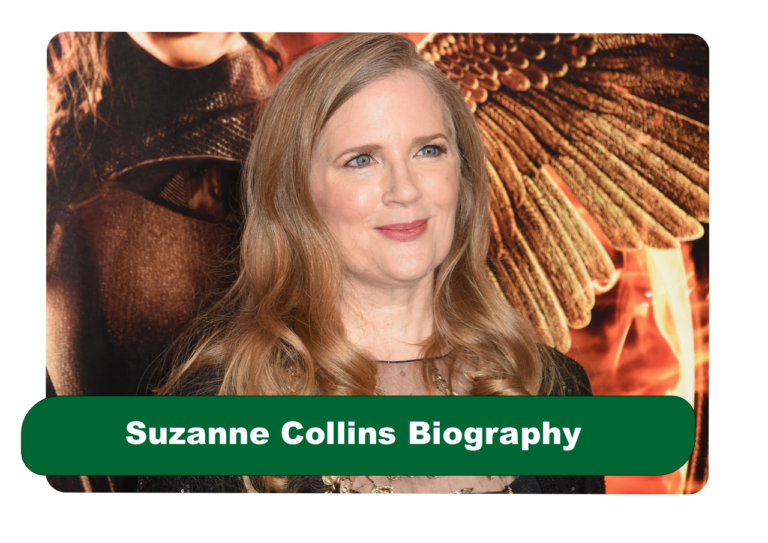
Suzanne Collins is a 63-year-old bestselling author known for The Hunger Games trilogy. Learn about her career, net worth, family, and latest books in 2026.
Suzanne Collins is one of the most influential authors of the 21st century. Best known for The Hunger Games trilogy, she created a dystopian world so vivid and politically resonant that it shaped an entire generation of readers and became one of the highest-grossing film franchises in history. Her books have been translated into over 85 languages and have sold more than 100 million copies worldwide — a figure that places her among the best-selling authors of all time.
What makes Collins’ story particularly compelling is that she didn’t arrive at novels through a conventional literary path. She spent nearly a decade writing for children’s television before a chance encounter with a fellow writer nudged her toward books. The result was a body of work that quietly redefined what young adult fiction could say about war, power, and survival.
Key Facts About Suzanne Collins
| Detail | Information |
|---|---|
| Full name | Suzanne Marie Collins |
| Date of birth | August 10, 1962 |
| Age (2026) | 63 years old |
| Birthplace | Hartford, Connecticut, USA |
| Profession | Author, screenwriter |
| Net worth (2026) | Approximately $90 million |
| Spouse | Charles “Cap” Pryor (married 1992) |
| Children | Two — Charlie and Isabel |
| Education | Indiana University (B.A., 1985); NYU Tisch School of the Arts (M.F.A., 1989) |
| Famous for | The Hunger Games trilogy, The Underland Chronicles |
Early Life and a Military Childhood
Suzanne Marie Collins was born on August 10, 1962, in Hartford, Connecticut. She was the youngest of four children born to Michael John Collins, a U.S. Air Force officer and military historian, and Jane Brady Collins. Her father’s career meant the family relocated frequently, moving across the eastern United States and spending time in Brussels, Belgium. It was an upbringing defined by constant change — and by her father’s deep engagement with history and the realities of war.
That military household left a lasting mark on Collins’ worldview. Her father made a deliberate effort to educate his children about conflict, poverty, and the human cost of warfare, taking them to battlefields and discussing history in frank, age-appropriate terms. Collins has cited these early conversations as foundational to the themes she would later explore in her fiction — particularly the moral weight of violence and the way governments use power over ordinary people.
Collins graduated from the Alabama School of Fine Arts in Birmingham in 1980, where she majored in theatre arts. It was an early signal of where her creative instincts lay, long before she put them to use on the page.
Education: Theatre, Telecommunications, and Dramatic Writing
After graduating high school, Collins enrolled at Indiana University, where she studied theatre and telecommunications, earning her B.A. in 1985. The combination was deliberate — she was drawn equally to storytelling and to the mechanics of broadcast media. She followed that degree with a Master of Fine Arts in dramatic writing from New York University’s prestigious Tisch School of the Arts, graduating in 1989.
Her graduate training in dramatic writing proved especially useful. It gave her a deep understanding of structure, character motivation, and the pace of a scene — skills that translate directly from the screen to the page, and that are visible in the breakneck momentum of The Hunger Games.
Television Writing: A Decade Behind the Scenes
Collins began her professional career in 1991 as a writer for children’s television, joining the staff of several Nickelodeon productions. She wrote for the Emmy-nominated Clarissa Explains It All and The Mystery Files of Shelby Woo, and contributed to preschool programs including Little Bear and Oswald. She later became head writer for Scholastic Entertainment’s Clifford’s Puppy Days and co-wrote a Rankin/Bass Christmas special, Santa, Baby!, which earned a Writers Guild of America Award nomination in animation.
It was during this period — while working on a Kids WB show called Generation O! — that Collins crossed paths with children’s author and illustrator James Proimos. He encouraged her to try writing books. She was also struck, around this time, by the contrast between the pastoral settings of classic children’s stories and the urban realities of modern childhood. That observation sparked Gregor the Overlander, the first of her five-book fantasy series The Underland Chronicles, published in 2003.
The Underland Chronicles earned strong reviews and a loyal readership. The series tackled themes of war and genocide with an unusual directness for middle-grade fiction, establishing Collins’ willingness to treat young readers as capable of engaging with genuinely difficult ideas.
The Hunger Games: Creating a Franchise and a Cultural Moment
The idea for The Hunger Games came to Collins one evening in 2006, when she was channel-surfing between reality television and news coverage from the Iraq War. The jarring contrast between entertainment and real-world conflict crystallized into a concept: a future society in which children are forced to fight to the death on live television as a form of political control. The Greek myth of Theseus and the Minotaur, and the historical figure of Spartacus, added further layers to the premise.
Scholastic Press published The Hunger Games in September 2008. Within months, it had become a phenomenon. The trilogy’s second book, Catching Fire, followed in 2009, and Mockingjay concluded the series in 2010. Within 14 months of the first two books’ release, 1.5 million copies had been printed in North America alone. The series spent more than 60 consecutive weeks on the New York Times bestseller list and made Collins Amazon’s best-selling author of all time.
The film adaptations — produced by Lionsgate and starring Jennifer Lawrence as Katniss Everdeen — began in 2012 and became one of the most successful franchises in cinema history. Collins co-wrote the screenplay for the first film and remained closely involved in the adaptations throughout. She has since expanded the Panem universe with two prequel novels: The Ballad of Songbirds and Snakes (2020), and Sunrise on the Reaping (2025), which focuses on themes of propaganda and the nature of submission to power. A film adaptation of the latter is scheduled for release in November 2026.
Personal Life and Privacy
Collins has been married to actor and television writer Charles “Cap” Pryor since 1992. The couple has two children, Charlie and Isabel, whom they have raised deliberately out of the public eye. The family lives in Sandy Hook, Connecticut, a small community that has been their home for many years.
Collins is notably private for someone of her cultural stature. She rarely gives interviews, does not maintain an active social media presence, and has consistently declined to make her personal life part of her public persona. That privacy seems to inform her writing as well — her books deal with visibility, surveillance, and the performance of identity in ways that feel deeply considered rather than incidental.
Net Worth and the Business of Panem
As of 2026, Suzanne Collins’ net worth is estimated at approximately $90 million. Her wealth derives from book royalties, film adaptation rights, screenplay fees, merchandise licensing, and the ongoing global revenue generated by The Hunger Games franchise. The film series alone contributed an estimated $60–70 million to her overall fortune. She holds significant intellectual property rights over the Panem universe, and the continued expansion of that universe — through prequels, new film adaptations, and international publishing deals — ensures that her earnings remain substantial well beyond the original trilogy.
Awards, Recognition, and Cultural Legacy
Time magazine named Collins one of the 100 Most Influential People in the World in 2010, a recognition of the speed and scale of The Hunger Games’ cultural impact. The books have been praised for their unflinching treatment of political violence, state propaganda, media manipulation, and trauma — themes that have only grown more relevant in the years since publication.
Educators and critics have noted that Collins brought a new seriousness to young adult fiction, demonstrating that books for teenagers could engage with the same moral and political complexity as adult literature. Her influence on subsequent dystopian fiction — from Divergent to The Maze Runner and beyond — is widely acknowledged within the publishing industry.
Wrapping Up
Suzanne Collins built her career in layers — a decade of television writing, a fantasy series that found a devoted audience, and then a trilogy that changed the landscape of young adult fiction permanently. None of it happened overnight, and that slow accumulation of craft is visible in the quality of the work. The Hunger Games is not a lucky accident; it is the product of someone who had been learning how stories work for twenty years before she wrote it.
At 63, with Sunrise on the Reaping released in 2025 and its film adaptation due in 2026, Collins shows no sign of stepping away from the world she created. If anything, her recent work suggests that she finds Panem as useful a lens as ever for examining the world as it actually is — a place where the powerful govern the many through spectacle, and where the question of what is real has never felt more urgent.
People Also Ask
What is Suzanne Collins best known for?
She is best known for The Hunger Games trilogy, a dystopian young adult series that has sold over 100 million copies worldwide and inspired a blockbuster film franchise starring Jennifer Lawrence. She is also the author of The Underland Chronicles, a five-book middle-grade fantasy series.
What inspired Suzanne Collins to write The Hunger Games?
Collins has described flipping between reality television and Iraq War news footage one evening and being struck by the disturbing contrast. Her father’s career as a U.S. Air Force officer and military historian also deeply informed the trilogy’s exploration of war, poverty, and political control. The Greek myth of Theseus and the Minotaur provided additional structural inspiration.
Did Suzanne Collins write the Hunger Games screenplays?
Yes — she co-wrote the screenplay for the first Hunger Games film (2012) and remained closely involved in the broader film adaptations. She has also written the source novels for the prequel films, including The Ballad of Songbirds and Snakes (2023) and the forthcoming adaptation of Sunrise on the Reaping (2026).
What did Suzanne Collins do before writing novels?
She spent nearly a decade writing for children’s television, working on Nickelodeon shows including Clarissa Explains It All and The Mystery Files of Shelby Woo, as well as serving as head writer for Clifford’s Puppy Days. Her transition into novels came after encouragement from author James Proimos.
Where does Suzanne Collins live?
She lives with her husband, Charles Pryor, and their two children in Sandy Hook, Connecticut.