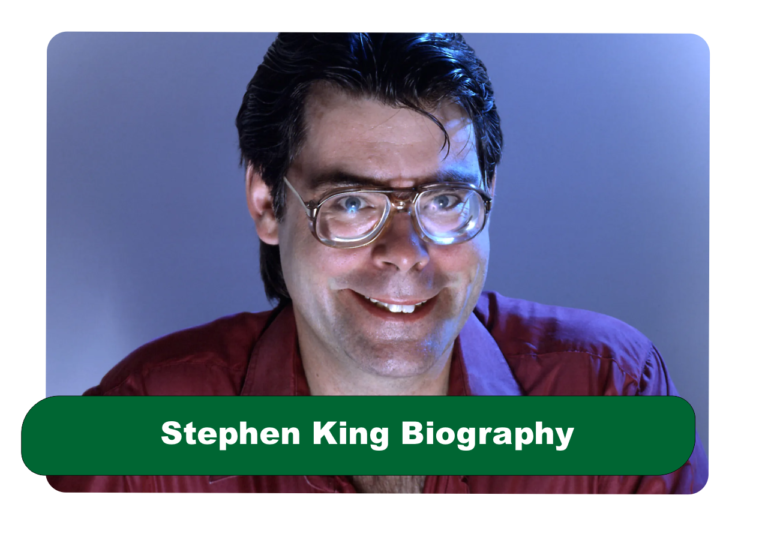
Stephen King is a 78-year-old American horror author with a $500M net worth. Explore his life, iconic novels, the Richard Bachman pseudonym, family, and lasting legacy.
Stephen Edwin King is the undisputed master of modern horror fiction. Born in Portland, Maine, in 1947, he has spent more than five decades frightening, moving, and captivating readers around the world with novels that go far deeper than genre conventions. From Carrie to It to The Shining, his bibliography reads like a roadmap of the American imagination at its darkest and most human. With over 350 million books sold worldwide, he is one of the best-selling authors in history.
What makes King remarkable is not just his output — over 65 novels, roughly 200 short stories, and seven books under a pseudonym — but his ability to sustain genuine cultural relevance across generations. He has been alternately dismissed as pulp entertainment and celebrated as a serious literary voice, and he has outlasted both judgments. In 2026, at 78 years old, he continues to write, publish, and provoke.
Quick Facts About Stephen King
| Detail | Information |
|---|---|
| Full name | Stephen Edwin King |
| Date of birth | September 21, 1947 |
| Age (2026) | 78 years old |
| Birthplace | Portland, Maine, USA |
| Profession | Author, screenwriter, producer |
| Net worth (2026) | Approximately $500 million |
| Spouse | Tabitha King (married January 1971) |
| Children | Naomi King, Joe Hill, Owen King |
| Education | University of Maine, BA in English (1970) |
| Pen name | Richard Bachman |
| Famous for | Carrie, The Shining, It, The Stand |
Early Life: Maine, Loss, and a Childhood Shaped by Darkness
Stephen King was born on September 21, 1947, in Portland, Maine. His father, Donald King, abandoned the family when Stephen was just two years old, leaving his mother, Nellie Ruth King, to raise Stephen and his adopted older brother David alone. The family moved frequently — through Wisconsin, Indiana, and Connecticut — before finally settling in Durham, Maine, a small town whose rural texture would later seep into much of King’s fiction.
His childhood was marked by both hardship and an early, consuming love of horror. He devoured EC Comics, particularly Tales from the Crypt, and was drawn to stories of monsters, dread, and the supernatural from an unusually young age. A traumatic incident — reportedly witnessing a friend being struck and killed by a train, though King has said he has no memory of the event itself — is often cited by those around him as a possible early imprint on his imagination.
He began writing for pleasure as a young boy, selling hand-typed stories based on movies to neighborhood children for a few cents. That entrepreneurial instinct for storytelling never left him. By his early teens, he was submitting short stories to magazines, collecting rejection slips in a growing stack he pinned to his bedroom wall with a nail.
Education and the First Sparks of a Writing Career
King attended Lisbon High School in Maine before enrolling at the University of Maine at Orono, where he earned a Bachelor of Arts in English in 1970. He was an engaged student who also contributed a column to the campus newspaper, and it was during his university years that he began writing seriously in earnest. It was also where he met Tabitha Spruce — his future wife, collaborator, and the first reader of Carrie — in the college library.
After graduating, King struggled financially. He worked as a janitor, a gas station attendant, and eventually a high school English teacher in Hampden, Maine, while continuing to write fiction in whatever hours he could find. These lean years were formative — not just financially but creatively — and the working-class anxiety of that period runs through much of his best work.
The Breakthrough: Carrie and the Birth of a Legend
King’s fortunes changed decisively in 1973. He had been writing Carrie — the story of a bullied teenage girl with telekinetic powers — and had thrown the early pages in the trash, convinced it wasn’t working. Tabitha retrieved the draft, read it, and encouraged him to continue. When the novel sold to Doubleday for $2,500, King was cautiously optimistic. When the paperback rights sold for $400,000 — netting him $200,000 — it was a turning point that allowed him to leave teaching and write full-time.
The 1976 Brian De Palma film adaptation of Carrie, starring Sissy Spacek, extended the novel’s reach far beyond the book world and established the template for what a Stephen King adaptation could be. King followed Carrie with ‘Salem’s Lot (1975) and The Shining (1977) in rapid succession, each a bestseller, each cementing a distinct and recognizable voice. Stanley Kubrick’s 1980 film adaptation of The Shining, despite King’s well-documented reservations about it, became one of the most iconic horror films ever made.
The Richard Bachman Secret
At the height of his popularity in the late 1970s and early 1980s, King faced an unusual problem: he was producing work faster than conventional publishing wisdom held the market could absorb. Publishers generally believed one novel per year per author was the acceptable limit, and King regularly exceeded that pace. His solution was the pseudonym Richard Bachman, a name he constructed from the crime novelist Richard Stark and the band Bachman-Turner Overdrive.
Under the Bachman name, King published seven novels — including The Long Walk (1979) and Thinner (1984) — that allowed him to explore darker, more experimental territory without risking his established brand. The alias also served as a creative experiment: King wanted to know whether his books sold on their own merit or on the strength of his name. The pseudonym was exposed in 1985 when a Washington, D.C. bookstore clerk named Steve Brown noticed the striking stylistic similarities between Bachman and King and traced the copyright records to their source. King characteristically responded with wit, announcing that Richard Bachman had died of “cancer of the pseudonym.”
A Career That Spans Generations
The 1980s and 1990s produced some of King’s most enduring work. It (1986), a sprawling novel about a shape-shifting entity terrorizing a small Maine town, became one of the defining horror novels of the 20th century. Misery (1987) was adapted into an Oscar-winning film with Kathy Bates in 1990. The Shawshank Redemption (1994), based on his novella, earned seven Academy Award nominations and is regularly cited as one of the greatest films ever made. The Green Mile (1999) followed a similar path from serialized novel to acclaimed film.
Beyond horror, King has proven himself a versatile author across genres — fantasy with The Dark Tower series, crime fiction with the Bill Hodges trilogy, and literary drama with The Body, the novella that became Stand by Me (1986). His nonfiction work On Writing: A Memoir of the Craft (2000), part memoir and part writing manual, is widely considered one of the finest books ever written about the craft of fiction.
A near-fatal accident in June 1999 — when King was struck by a van while walking near his home in Bangor — interrupted but did not stop him. He suffered a collapsed lung, broken hip, and multiple other injuries. He returned to writing within weeks, finishing the memoir he’d been working on from his hospital bed, and has never truly slowed down.
Personal Life and Family
King married Tabitha Spruce on January 2, 1971. She is an accomplished novelist in her own right, and their partnership — now spanning more than five decades — is one of the most enduring in American literary life. Together they have three children: daughter Naomi King, who became an ordained Unitarian Universalist minister, and sons Joe Hill and Owen King, both of whom are published novelists. Joe Hill, in particular, has earned significant recognition as a horror writer in his own right.
The family is rooted in Maine. King and Tabitha have long lived in a Victorian mansion in Bangor that has become something of a landmark for fans, its wrought-iron gate famously adorned with bats and spiders. They also own a summer home in Lovell, Maine, and a waterfront property in Sarasota, Florida. Despite his extraordinary wealth, King has frequently described himself as leading a relatively modest life. He is known to drive ordinary cars, shop locally, and remain deeply connected to the communities of Maine that shaped him.
Net Worth and Financial Legacy
As of 2026, Stephen King’s net worth is estimated at approximately $500 million, with annual earnings reportedly in the $15–20 million range. His wealth flows from multiple streams: decades of book royalties from titles that have never gone out of print, film and television adaptation rights, speaking engagements, and new publications that consistently reach bestseller lists. The 2017 and 2019 It films alone — the first of which became the highest-grossing horror film of all time — generated enormous new interest in his back catalog.
King has also been notably generous with his fortune. He and Tabitha have donated millions to libraries, literacy programs, and scholarships in Maine, and have been vocal supporters of causes ranging from gun control to local arts funding. His philanthropic work, though less publicized than his fiction, reflects a consistent investment in the communities and culture that made him.
Awards and Recognition
King’s trophy shelf reflects both commercial dominance and eventual critical embrace. He is the recipient of the National Medal of Arts (2014), the National Book Foundation Medal for Distinguished Contribution to American Letters (2003), the PEN America Literary Service Award (2018), multiple Bram Stoker Awards, the World Fantasy Award for Life Achievement (2004), and the Grand Master Award from the Mystery Writers of America (2007), among dozens of others. He has received more than 40 major literary awards and over 180 nominations across his career.
For decades, King was viewed by certain literary gatekeepers as a populist entertainer unworthy of serious critical attention — a bias he wore with wry resignation. That began to shift in the 1990s and was fully cemented by the mid-2000s, when the literary establishment finally caught up with what readers had known all along.
Final Thoughts
Stephen King’s legacy is not simply one of prolific output or commercial dominance, though both are extraordinary by any measure. It is the legacy of a writer who understood, more clearly than almost anyone, that fear is a doorway into the full range of human experience. His best novels are not really about monsters — they are about grief, addiction, childhood, loneliness, the failure of institutions, and the peculiar heroism of ordinary people. The monsters are just how you get readers through the door.
At 78, King remains active, outspoken, and creatively engaged. He continues to publish, continues to divide opinion, and continues to be read by millions of people who may never think of themselves as horror fans but find in his pages something they recognize and cannot name. That is a rare achievement, and it belongs entirely to him.
People Also Ask
How many books has Stephen King written?
King has published over 65 novels and approximately 200 short stories, plus seven novels under the pseudonym Richard Bachman and several works of nonfiction. His books have collectively sold more than 350 million copies worldwide.
What is Stephen King’s most famous book?
While opinions vary widely, It (1986) and The Shining (1977) are most frequently cited as his defining works. The Shawshank Redemption — based on his novella Rita Hayworth and Shawshank Redemption — is arguably his most beloved film adaptation.
Why did Stephen King use the name Richard Bachman?
King adopted the pseudonym in the late 1970s partly because publishers believed one book per year per author was the market limit, and partly as a personal experiment to see whether his books would succeed without his famous name attached. The alias was exposed in 1985 by a bookstore clerk who traced copyright records.
Who are Stephen King’s children?
He has three children with wife Tabitha King: daughter Naomi King, and sons Joe Hill and Owen King. Both Joe Hill and Owen King are published novelists, making the Kings one of the most remarkable literary families in American letters.
Has Stephen King won any major literary awards?
Yes — among many others, he has received the National Medal of Arts (2014), the National Book Foundation’s Medal for Distinguished Contribution to American Letters (2003), the PEN America Literary Service Award (2018), the World Fantasy Award for Life Achievement (2004), and multiple Bram Stoker Awards.