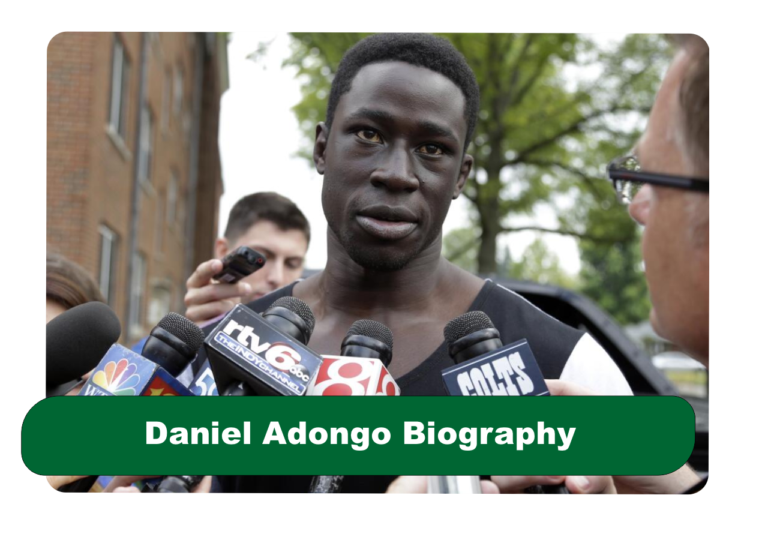
Daniel Adongo is a 37-year-old Kenyan former rugby and NFL player who made history as the first Kenyan to play in the NFL. Read his full life story, career, and 2026 deportation.
Daniel Adongo is one of the most remarkable — and ultimately tragic — stories in modern sports. Born in Nairobi, Kenya, he rose from the rugby fields of East Africa to become the first Kenyan-born player to compete in the National Football League, signing with the Indianapolis Colts in 2013 despite having zero prior experience in American football. His story captivated the world not just because of how improbable it was, but because of how completely it unraveled.
In June 2026, Adongo was deported from the United States to Kenya by ICE, bringing a painful close to a chapter that had once promised so much. His journey from historic trailblazer to cautionary tale raises uncomfortable questions about how professional sports systems support — or fail to support — the athletes who pass through them.
Quick Facts About Daniel Adongo
| Detail | Information |
|---|---|
| Full name | Daniel Ojambo Adongo |
| Date of birth | October 12, 1989 |
| Age (2026) | 36 years old |
| Birthplace | Nairobi, Kenya |
| Nationality | Kenyan |
| Profession | Former rugby player, former NFL linebacker |
| NFL team | Indianapolis Colts (2013–2015) |
| Position | Outside linebacker / special teams |
| Height | 6 ft 5 in (1.96 m) |
| Weight | 247–270 lb (112–122 kg) |
| Education | Strathmore School, Nairobi; University of Pretoria |
| Famous for | First Kenyan-born player in NFL history |
Early Life and Family
Daniel Ojambo Adongo was born on October 12, 1989, in Nairobi, Kenya, into a middle-class family. He grew up in a city where American football was virtually unknown, but sport was always central to his life. At Strathmore School in Nairobi, he excelled across multiple disciplines — setting a school high jump record and earning the title of Sportsman of the Year. It was there that his rare physical gifts, already evident in his towering frame and natural athleticism, began attracting serious attention.
He started his rugby journey with the Kenya Harlequins junior team, a club with deep roots in Nairobi’s sporting culture. His breakthrough came in 2006, when South African scouts spotted him at the Safari Sevens tournament, playing in the schools category. Standing over six feet tall and weighing more than 120 kilograms as a teenager, Adongo was unmissable. The scouts knew immediately they were looking at something special.
Rugby Career: From Nairobi to the Southern Hemisphere
In 2007, at just 17 years old, Adongo made the bold move to South Africa, joining the Sharks Academy in KwaZulu-Natal. He became the first Kenyan player signed to a junior contract with the Sharks — a milestone in itself. He progressed steadily through the academy system, moving from Under-19 to Under-21 level by 2010.
He later moved to Pretoria, joining the Blue Bulls and studying at the University of Pretoria. In 2012, he gained international experience in New Zealand, playing for Counties Manukau — becoming the first Kenyan to play Super Rugby in the process. By 2013, he was playing for the Southern Kings in that year’s Super Rugby season, cementing his status as a legitimate professional rugby player on the global stage.
Making NFL History: The Indianapolis Colts
The pivot to American football was improbable by any measure. In 2013, Adongo’s Hong Kong-based agent, John Gbenda Charles, reached out to the Indianapolis Colts with an unusual proposal: convert this Kenyan rugby star into an NFL outside linebacker. The Colts, who had been actively exploring international rugby talent for transferable athletic skills, were immediately intrigued. Adongo’s combination of size, speed, and explosive power was the kind of raw material coaches dream about.
He arrived at Colts training camp in the summer of 2013 having never played a down of organized American football. His only prior exposure to the game had been playing Madden video games in South Africa and watching NFL broadcasts in Nairobi as a child. The learning curve was immense. Yet the Colts’ coaching staff saw enough in him to keep developing his pass-rushing technique and special teams role.
On December 8, 2013, Adongo made his NFL debut against the Cincinnati Bengals — becoming the first Kenyan-born player ever to appear in an NFL game. The moment was historic, widely covered in Kenya and across Africa, and held up as proof that the NFL’s international talent pipeline could yield results from entirely unexpected places. He went on to play in five games total across two seasons before Indianapolis released him in December 2015.
Life After the NFL: A Difficult Descent
The years following his NFL release were hard. Adongo’s visa expired in 2016, and he remained in the United States without legal status. Without the structure of professional sport, the support systems around him disappeared. His family later said publicly that he had been dealing with serious mental health struggles, and that possible injuries sustained during his playing career may have contributed to his deteriorating condition.
Court records revealed that a judge found Adongo incompetent to stand trial following a psychiatric evaluation in 2017, and he received treatment at a psychiatric facility. Despite this, legal troubles continued to accumulate over the following years — arrests on charges including felony intimidation, battery, and disorderly conduct. In 2020, he was convicted of criminal mischief causing damage and sentenced to 364 days in prison.
Videos that circulated online around 2020 showed Adongo in a visibly distressed state, prompting his father, Joe Adongo, to speak publicly about his son’s struggles. The family’s account painted a picture of a man whose life had been overwhelmed by a combination of mental health crises, loss of identity after sport, and inadequate support.
Deportation: June 2026
In March 2026, a Department of Justice immigration judge formally ordered Adongo’s removal from the United States. He had been held at the Miami Correctional Facility in Bunker Hill, Indiana, under provisions of the Laken Riley Act — federal legislation signed into law by President Donald Trump in January 2025, which mandates detention without bond for undocumented individuals with qualifying criminal histories.
On June 20, 2026, Adongo was deported from Chicago back to Kenya, ending more than a decade of life in the United States. ICE announced the removal publicly, with DHS issuing a statement that described him as a community threat. The language used by federal officials stood in stark contrast to how the same country had celebrated his arrival thirteen years earlier.
His deportation drew widespread commentary, particularly around questions of how the United States immigration and criminal justice systems handle athletes who arrive on temporary visas and are then left without a safety net when their careers end. Several legal observers noted that his documented mental health history and findings of incompetency added complexity to how his case had been handled.
Legacy and Impact
Whatever the circumstances of his final years in the United States, Daniel Adongo’s place in history is secure. He was the first Kenyan to play Super Rugby and the first Kenyan-born athlete to compete in the NFL — two barriers broken in the same decade, in two entirely different sports. For a generation of young Kenyan athletes, that double landmark carried real meaning.
His story also became a lens through which broader conversations about athlete welfare, immigration policy, and mental health in professional sports have been examined. The same physical attributes that made him a remarkable specimen on the field — size, aggression, explosive power — offered no protection against the psychological and institutional forces that shaped his later life. In that sense, his biography is not just about sport. It is about what happens when the spotlight moves on.
Wrapping Up
Daniel Adongo’s life contains one of the most improbable rises in sports history and one of the most sobering falls. From a school sports field in Nairobi to an NFL debut in Cincinnati, he travelled a distance — physically and metaphorically — that almost no athlete has replicated. The fact that his story ended with a deportation order rather than a coaching role or a commentator’s chair says as much about the systems around him as it does about the man himself.
He is back in Kenya now, the country that produced him, in a chapter that remains unwritten. What is already written, however, is permanent: Daniel Adongo was the first. No one can take that from him.
People Also Ask
Who is Daniel Adongo?
Daniel Adongo is a 36-year-old Kenyan former professional rugby player and NFL linebacker. He made history in 2013 as the first Kenyan-born player to sign with and appear in a game for an NFL team, the Indianapolis Colts, despite having no prior experience in American football.
What happened to Daniel Adongo after the NFL?
After the Colts released him in 2015, Adongo’s visa expired in 2016 and he remained in the United States without legal status. He experienced serious mental health difficulties and accumulated a criminal record over the following years, eventually leading to his deportation to Kenya in June 2026.
Why was Daniel Adongo deported?
ICE deported Adongo on June 20, 2026, following a removal order issued by a Department of Justice immigration judge in March 2026. The agency cited his visa overstay from 2016 and a criminal record that included arrests for felony intimidation, battery, and disorderly conduct, as well as a 2020 criminal mischief conviction.
What records did Daniel Adongo set?
He became the first Kenyan to play Super Rugby (with the Southern Kings in 2013) and the first Kenyan-born player to appear in an NFL game (with the Indianapolis Colts in December 2013). He was also the first Kenyan signed to a junior rugby contract with the Sharks Academy in South Africa.
Where is Daniel Adongo now?
As of mid-2026, Daniel Adongo has been deported and returned to Kenya following his removal from the United States by ICE on June 20, 2026.