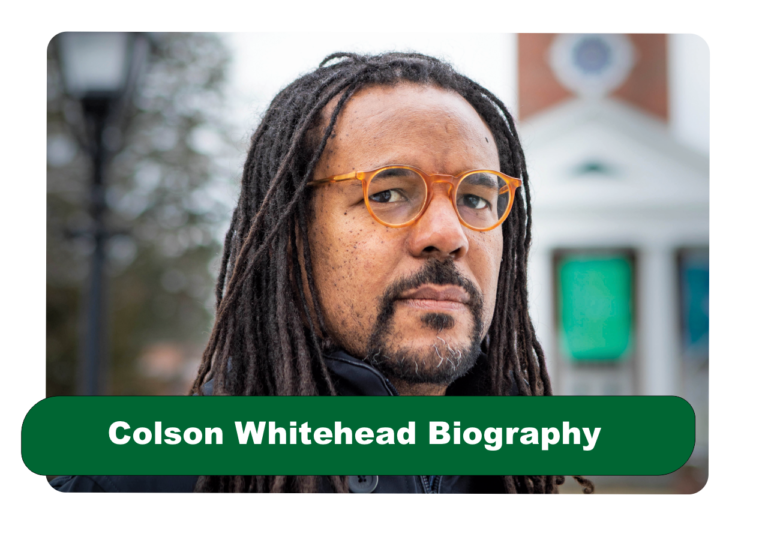
Colson Whitehead, 56, is the only author to win back-to-back Pulitzer Prizes for fiction. Explore his life, landmark novels, Harlem Trilogy, and literary legacy.
Colson Whitehead is one of the most decorated American novelists alive. The New York-born author has built a body of work spanning more than three decades that is as diverse as it is acclaimed — ranging from speculative fiction and zombie horror to searing historical drama and Harlem crime sagas. He is the only writer in history to win the Pulitzer Prize for Fiction for two consecutive novels, a distinction that places him in rare company in American letters.
What makes Whitehead’s career remarkable is not just the awards, but the refusal to repeat himself. Each book arrives in a different register — genre, voice, and subject matter shift from one novel to the next — yet a consistent moral intelligence runs through all of it. Whether he is writing about a literal underground railroad, a reformatory school built on terror, or a Harlem furniture dealer with a sideline in stolen goods, Whitehead is always asking the same essential questions about race, survival, and the cost of ambition in America.
Quick Facts About Colson Whitehead
| Detail | Information |
|---|---|
| Full name | Arch Colson Chipp Whitehead |
| Date of birth | November 6, 1969 |
| Age (2026) | 56 years old |
| Birthplace | New York City, New York, USA |
| Profession | Novelist, essayist |
| Net worth (2026) | Approximately $5–10 million (estimated) |
| Spouse | Julie Barer (literary agent) |
| Children | 2 |
| Education | Trinity School, Manhattan; Harvard University (BA, 1991) |
| Famous for | The Underground Railroad, The Nickel Boys, Harlem Trilogy |
Early Life and Family
Arch Colson Chipp Whitehead was born on November 6, 1969, in New York City. He grew up in Manhattan, where the city’s layered social geography — its neighborhoods, its history, its fault lines of race and class — would eventually become his most enduring subject. Details about his parents and siblings have remained largely private throughout his public life, a reflection of the quiet, intensely literary world he has long inhabited.
Whitehead attended the Trinity School, one of Manhattan’s elite preparatory institutions. It was an education that gave him both academic rigor and early exposure to the literary canon he would later rework in his own image. New York was his classroom in the broader sense too — a place he has returned to again and again as both setting and protagonist across his twelve books.
Education and Early Influences
After Trinity, Whitehead enrolled at Harvard University, where he graduated with a bachelor’s degree in 1991. While at Harvard, he was friends with poet Kevin Young — a relationship that speaks to the literary circles he was already moving in as a young man. Whitehead has cited a wide range of influences across his career, from genre fiction to African American literary tradition, and his Harvard years appear to have deepened that eclectic sensibility.
He began his professional life at The Village Voice, working as a critic and cultural writer. It was there that he met writer and photographer Natasha Stovall; the two married and had a daughter before later divorcing. The Village Voice years also gave him an early platform and sharpened the critical voice that would eventually find its fullest expression in his fiction.
A Career Built on Reinvention
Whitehead published his debut novel, The Intuitionist, in 1999. The book — a genre-bending story about elevator inspectors and racial allegory in a mid-century American city — announced him immediately as a writer of unusual ambition and imagination. It won the Quality Paperback Book Club New Voices Award and established a template for his work: familiar genre conventions bent toward deeper social meaning.
John Henry Days followed in 2001, a sprawling, maximalist novel about the legend of John Henry and the machinery of American myth-making. It was a finalist for the Pulitzer Prize and the National Book Critics Circle Award. Zone One (2011) arrived as a literary zombie novel — using the genre to meditate on trauma, memory, and the aftermath of catastrophe. His memoir-adjacent The Noble Hustle (2014) documented his experience playing in the World Series of Poker and became a cult favorite among readers who appreciated his wry, self-deprecating prose.
The turn that changed everything came in 2016 with The Underground Railroad. The novel reimagined the historical network of escape routes for enslaved people as a literal subterranean railway system, following a young enslaved woman named Cora as she flees a Georgia plantation. It won the National Book Award for Fiction in 2016 and the Pulitzer Prize for Fiction in 2017. Three years later, The Nickel Boys (2019) — inspired by the real horrors of the Dozier School for Boys in Florida — won Whitehead his second Pulitzer, making him the first and only author to win the prize for two consecutive novels.
The Harlem Trilogy: Crime Fiction as Social History
In 2021, Whitehead launched what would become his most commercially beloved project. Harlem Shuffle introduced Ray Carney, a furniture store owner in 1960s Harlem with a quiet sideline as a fence for stolen goods. The novel used crime fiction as a lens for examining upward mobility, neighborhood politics, and the moral compromises of Black middle-class life. It was a bestseller and a critical success, praised for its propulsive plotting and sharp social observation.
Crook Manifesto (2023) continued Carney’s story into the 1970s, a decade defined by New York’s fiscal crisis, rising crime, and the Blaxploitation era. The second volume was equally well received, cementing the trilogy’s reputation as a love letter to Harlem across time. Cool Machine, published by Doubleday on July 21, 2026, brings the trilogy to its conclusion. Set in 1980s New York — a city emerging from near-bankruptcy into the Reagan era of rampant development and widening inequality — it follows an older Ray Carney as he takes on one last major job and attempts to rescue a relative from the city’s worst forces. Publishers Weekly gave it a starred review, calling it the “greatest New York novel in years.” Cool Machine is Whitehead’s twelfth book in under three decades.
Personal Life
After his first marriage to Natasha Stovall ended in divorce around 2011, Whitehead married Julie Barer, a prominent New York literary agent. The couple have one child together, and Whitehead is also a father from his first marriage. He has spoken openly about his writing routine, noting that he writes while his children are at school — a deliberate structuring of creative time around family life that feels characteristic of his grounded, unflashy approach to the author’s life.
Whitehead has lived in New York for essentially his entire life. The city is not just his home but his obsession — the Harlem Trilogy in particular reads as a sustained act of love for a neighborhood and an era he clearly finds inexhaustible. He has spoken in interviews about New York as a place where ambition and survival have always been intertwined, and where the stories of ordinary people contain more drama than most fiction can hold.
Awards, Honors, and Recognition
The list of Whitehead’s honors is extraordinary even by the standards of major literary careers. He received a MacArthur Fellowship — the so-called “genius grant” — in 2002, and a Guggenheim Fellowship in 2013. In 2020, he was awarded the Library of Congress Prize for American Fiction, becoming its youngest recipient at the time. That same year, he won his second Pulitzer Prize for The Nickel Boys. In 2021, he received the National Humanities Medal. In 2024, he was awarded the City College of New York’s Langston Hughes Medal, which honors distinguished writers from the African American diaspora. He also served as New York State author laureate from 2018 to 2020.
His individual novel awards include the National Book Award for Fiction (2016), two Pulitzer Prizes for Fiction (2017 and 2020), the Carnegie Medal for Excellence in Fiction, and the Hurston/Wright Award for fiction. The Nickel Boys was also adapted into a film released in 2024, directed by RaMell Ross, which received significant award season attention.
Net Worth and Income
Whitehead’s net worth is estimated at between $5 million and $10 million as of 2026. His income comes from book sales, royalties on backlist titles, advances on new work, speaking engagements, university teaching positions, and adaptation deals. The film adaptation of The Nickel Boys and the continued commercial success of the Harlem Trilogy have kept his work in public view and his backlist robust. For a literary novelist — a category not typically associated with large financial rewards — Whitehead sits at the rare intersection of critical prestige and genuine commercial reach.
Literary Legacy and Influence
Whitehead’s significance to American literature extends well beyond his award count. He has demonstrated, over twelve books and nearly three decades, that literary fiction can absorb genre conventions without being diminished by them — that a zombie novel, a heist story, or a speculative alternate history can carry the same moral and intellectual weight as any work in the realistic tradition. He has also produced some of the most important fiction about the African American experience in the twenty-first century, placing him in a lineage that includes Toni Morrison, James Baldwin, and Ralph Ellison without simply imitating any of them.
At 56, with Cool Machine marking the close of one major project, Whitehead shows no signs of slowing. If his career to date is any guide, the next turn will be unexpected.
Wrapping Up
Colson Whitehead’s career is a study in disciplined reinvention. He has never allowed critical success to calcify into formula, moving instead from one form to another with the confidence of a writer who trusts that the subject, not the genre, is what matters. Two Pulitzer Prizes, a MacArthur Fellowship, and twelve books later, he remains one of the most vital and unpredictable voices in American fiction.
Cool Machine, published in July 2026, closes one of the most celebrated trilogies in recent American crime fiction. It is a fitting capstone to a body of work defined by its moral seriousness, its wit, and its unshakeable commitment to telling the truth about the city and the country that made it.
People Also Ask
What is Colson Whitehead best known for?
He is best known for The Underground Railroad (2016) and The Nickel Boys (2019), both of which won the Pulitzer Prize for Fiction. He is the only author in history to win the prize for two consecutive novels.
What is Colson Whitehead’s latest book?
His latest book is Cool Machine (July 2026), the third and final volume of the Harlem Trilogy. It is set in 1980s New York and follows recurring protagonist Ray Carney, a furniture dealer and fence, on one last major heist.
What is the Harlem Trilogy?
The Harlem Trilogy is a series of three crime novels set in different decades of New York City’s history: Harlem Shuffle (1960s, 2021), Crook Manifesto (1970s, 2023), and Cool Machine (1980s, 2026). All three follow Ray Carney and are published by Doubleday.
Where did Colson Whitehead go to school?
He attended Trinity School in Manhattan and then Harvard University, graduating with a bachelor’s degree in 1991.
Is Colson Whitehead married?
Yes. He is currently married to Julie Barer, a literary agent. He was previously married to writer and photographer Natasha Stovall, with whom he has a daughter.