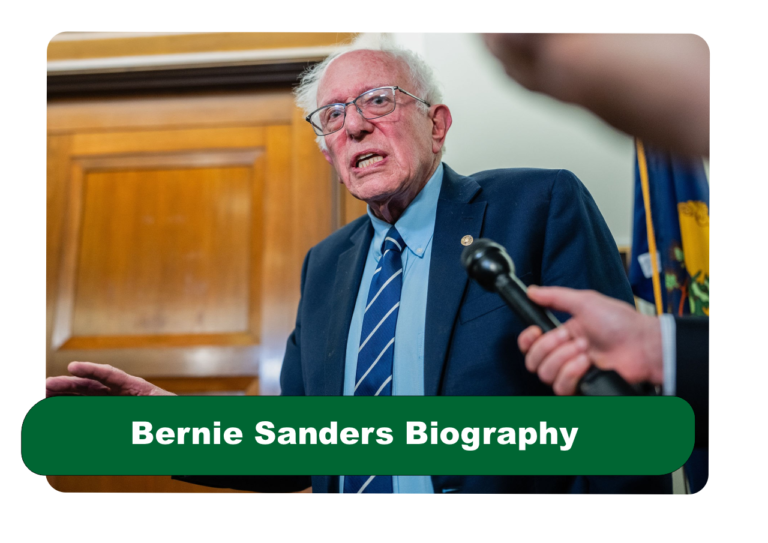
Bernie Sanders is an 84-year-old U.S. Senator from Vermont and two-time presidential candidate. Explore his political career, progressive legacy, family, and net worth in 2026.
Bernie Sanders is one of the most consequential political figures in modern American history. Born in Brooklyn and shaped by working-class values, he built a decades-long career on a single, consistent message: the economic and political system is rigged in favor of the wealthy, and it needs to change. As the longest-serving independent in U.S. congressional history and a two-time presidential candidate, Sanders transformed from a little-known Vermont mayor into the defining voice of American progressivism.
What makes Sanders remarkable is not just the longevity of his career but the consistency of it. The positions he holds today on healthcare, wealth inequality, workers’ rights, and corporate power are essentially identical to those he articulated in the 1970s and 1980s — long before they became mainstream Democratic talking points. Few politicians of any era can claim that kind of ideological durability.
Quick Facts About Bernie Sanders
| Detail | Information |
|---|---|
| Full name | Bernard Sanders |
| Date of birth | September 8, 1941 |
| Age (2026) | 84 years old |
| Birthplace | Brooklyn, New York, USA |
| Profession | U.S. Senator, politician, author |
| Political affiliation | Independent (caucuses with Democrats) |
| Net worth (2026) | Approximately $3 million |
| Spouse | Jane O’Meara Sanders (married 1988) |
| Children | One biological son (Levi Sanders); three stepchildren |
| Education | B.A. in Political Science, University of Chicago (1964) |
| Famous for | 2016 & 2020 presidential campaigns, Medicare for All, longest-serving independent in Congress |
Early Life and Brooklyn Roots
Bernard Sanders was born on September 8, 1941, in the Flatbush neighborhood of Brooklyn, New York. He grew up in a modest apartment in a working-class Jewish family. His father, Elias Sanders, had emigrated from Poland and worked as a paint salesman; his mother, Dorothy, managed the household. Money was consistently tight, and Sanders has said the financial stress he witnessed as a child planted the seeds of his lifelong preoccupation with economic inequality.
He has one older brother, Larry Sanders, who went on to become a politician and social activist in the United Kingdom. The two brothers remained close throughout their lives. The experience of growing up without financial security in one of New York’s outer boroughs left a mark that decades of political success never fully erased — and which Sanders himself has frequently cited as the origin of his politics.
Education and Early Political Awakening
Sanders attended Brooklyn College briefly before transferring to the University of Chicago, where he earned a Bachelor of Arts in Political Science in 1964. His time in Chicago was formative in ways that went beyond the classroom. He became active in the Civil Rights Movement, joining the Congress of Racial Equality (CORE) and participating in sit-ins and demonstrations. He was arrested at least once during a protest against segregated schools in Chicago — an event he has described as one of the most significant of his life.
After graduating, Sanders moved to Vermont in 1968, drawn by the state’s counterculture community and open land. He tried various occupations — carpenter, filmmaker, writer — before finding his footing in politics. In the early 1970s, he co-founded the Liberty Union Party and ran unsuccessfully for governor and Senate several times. These were formative losses that sharpened both his message and his understanding of grassroots organizing.
Political Career: From Burlington’s Mayor to the U.S. Senate
Sanders won his first election in 1981, defeating the incumbent mayor of Burlington, Vermont, by just ten votes. His tenure as mayor lasted eight years across four terms, during which he focused on affordable housing, environmental policy, and expanding arts funding. National media took notice, and The New York Times ran features on what they called “the socialist mayor of Burlington” — a label Sanders wore without apology.
In 1990, he ran for Vermont’s single congressional seat and won, becoming the first independent elected to the House of Representatives in over forty years. He served in the House from 1991 to 2007, building a reputation as a consistent dissenter — one of the few members of Congress to vote against the Iraq War in 2002 and the Patriot Act, and a persistent critic of trade deals he argued hurt American workers. In 2006, he won Vermont’s open Senate seat and has held it ever since. He was re-elected to a fourth six-year term in 2024.
In the Senate, Sanders has chaired the Budget Committee (2021–2023) and the Health, Education, Labor and Pensions (HELP) Committee (2023–2025), using both platforms to hold corporations and pharmaceutical companies to public account. As of 2026, he serves as Ranking Member of the HELP Committee and remains an active voice on labor, healthcare, and economic legislation. In July 2026, he announced support for progressive candidates across more than five dozen state and local races ahead of the midterm elections, framing the effort as part of a long-term project to build a durable progressive governing coalition.
Two Presidential Campaigns That Moved the Needle
Sanders ran for the Democratic presidential nomination twice — in 2016 and 2020 — and lost both times, but the impact of his campaigns extended far beyond the ballot count. In 2016, he won 23 states and 46% of pledged delegates against Hillary Clinton, a result that stunned the political establishment and signaled a significant appetite for left-wing populism within the Democratic base. His campaign popularized ideas — Medicare for All, tuition-free public college, a $15 federal minimum wage, breaking up big banks — that were largely dismissed as fringe positions when he began and are now central to Democratic debate.
In 2020, he entered the race as an early frontrunner and dominated the first three contests. His campaign raised $25.3 million in a single quarter and drew enormous crowds. However, after a consolidation of moderate candidates around Joe Biden following Super Tuesday, Sanders suspended his campaign in April 2020 and endorsed Biden. He subsequently worked with the Biden campaign on a series of policy task forces, influencing provisions in the American Rescue Plan and the Inflation Reduction Act.
Books, Writing, and Public Voice
Beyond legislation and campaigning, Sanders has built a substantial body of written work. His books include Outsider in the White House (1997, updated 2015), Our Revolution (2016), Where We Go from Here (2018), and It’s OK to Be Angry About Capitalism (2023). The last of these became a bestseller and reinforced his identity not just as a politician but as a public intellectual willing to make an explicitly anti-capitalist argument in mainstream American publishing.
In 2022 alone, he earned an estimated $170,000 in book royalties — a figure that has drawn occasional commentary given his frequent critiques of concentrated wealth. Sanders has addressed this directly, noting that his income comes entirely from public service and book sales rather than corporate directorships, speaking fees from Wall Street, or investment portfolios.
Personal Life and Family
Sanders has been married to Jane O’Meara Sanders since 1988. Jane, who holds a doctorate in leadership studies, served as president of Burlington College from 2004 to 2011 and has been a close adviser and partner throughout his national campaigns. He has one biological son, Levi Sanders, who has worked as a political organizer and ran unsuccessfully for Congress in New Hampshire. He also has three stepchildren from Jane’s previous relationship.
The couple owns three properties: a townhouse in Burlington, Vermont, a lakefront home in North Hero, Vermont, and a condominium in Washington, D.C. Sanders has spoken candidly about the fact that the North Hero home, purchased in 2016, attracted criticism — some felt it contradicted his anti-wealth messaging. His response has been that owning a modest vacation home is not equivalent to hoarding wealth, and that the critique conflates personal financial comfort with the systemic issues he has spent his career addressing.
Net Worth and Financial Transparency
As of 2026, Bernie Sanders’ net worth is estimated at approximately $3 million — a modest figure relative to most of his Senate colleagues. His income derives from his annual Senate salary of $174,000, a federal pension accumulated over decades of congressional service, book royalties, and the appreciated value of his real estate holdings. He has never taken corporate speaking fees, PAC money, or consultant income, a distinction he has maintained as a point of principle throughout his career.
The relative modesty of his wealth is striking in a Senate where many members are millionaires many times over. His financial disclosures have been among the more straightforward in Congress, and he has used his own position as a counterexample when arguing that public service should not be a path to personal enrichment.
Legacy and Lasting Impact
Bernie Sanders did not win the presidency, but his influence on American politics in the 21st century is difficult to overstate. Ideas he championed when they were considered unelectable — a $15 minimum wage, expanded Medicare, student debt relief, taxing the ultra-wealthy — have moved from the political margins to the center of Democratic policy debate. A generation of progressive politicians, from Alexandria Ocasio-Cortez to numerous state legislators, cite his campaigns as the catalyst for their own political involvement.
At 84, Sanders shows no sign of retreating. In 2026 he continues to introduce legislation, endorse candidates, and use his Senate platform to challenge what he calls the oligarchic concentration of wealth and power in American life. Whether one agrees with his politics or not, his career represents a rare thing: a politician who said the same things for fifty years and eventually watched the world move toward him.
Final Thoughts
Bernie Sanders built his political life on a simple, stubborn premise — that ordinary people deserve an economy and a government that works for them, not just for those at the top. He said it as a young activist in Chicago, as mayor of a small New England city, as a House member largely ignored by his colleagues, and as a senator who twice nearly won the Democratic presidential nomination.
His story is not one of triumph in the conventional sense. He never won the presidency. Many of his flagship proposals remain unrealized. But the measure of his impact is visible not in legislation passed but in the terms of debate fundamentally shifted. In that sense, Bernie Sanders may be one of the most politically effective losers in American history — and he would probably take that as a compliment.
People Also Ask
What is Bernie Sanders known for?
Sanders is best known for his two presidential campaigns in 2016 and 2020, his advocacy for Medicare for All and tuition-free public college, and his status as the longest-serving independent in U.S. congressional history. He has represented Vermont in the Senate since 2007.
Is Bernie Sanders still in the Senate in 2026?
Yes. Sanders won re-election to a fourth six-year Senate term in 2024 and remains an active senator. He currently serves as Ranking Member of the Senate HELP Committee and has been actively endorsing progressive candidates in the 2026 midterms.
What party does Bernie Sanders belong to?
Sanders is officially an Independent, though he caucuses with the Democratic Party and sought the Democratic presidential nomination in both 2016 and 2020. He has never formally joined the Democratic Party.
How did Bernie Sanders make his money?
His wealth comes from his Senate salary ($174,000/year), a federal congressional pension, book royalties from bestsellers like Our Revolution and It’s OK to Be Angry About Capitalism, and real estate appreciation on his three Vermont and D.C. properties.
Who is Bernie Sanders married to?
Sanders has been married to Jane O’Meara Sanders since 1988. Jane holds a doctorate in leadership studies and served as president of Burlington College. She has been a key partner and adviser throughout his national political campaigns.